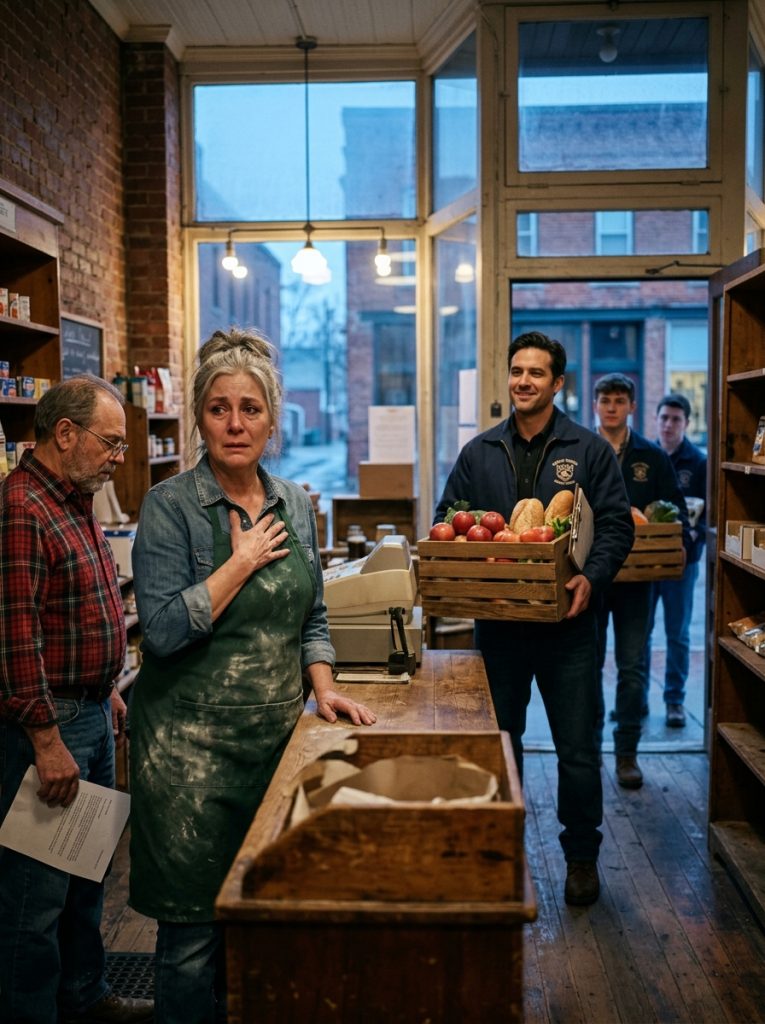
“You probably don’t remember me,” he said again. “Theo. Theo Brandt.”
And then I did.
Fifteen years fell away in the cold doorway, and I saw a skinny boy in a thin jacket who used to come in after dark, when he thought no one would notice, and stand a long time in front of the bread.
He was maybe sixteen then. His mother was sick. His father was gone. He’d count change in his palm and put half of what he wanted back on the shelf.
I never let him put it back. I’d bag it up and tell him it was day-old, even when it wasn’t, and slide it across the counter like it was nothing. Hector started leaving “mistake” sandwiches that the deli “couldn’t sell.” For two winters that boy ate out of our mistakes.
Then they moved away, and I prayed for him sometimes, the way you do for people who pass through your hands and out of your life.
Now he was standing in my doorway at dawn in a good coat, with three trucks behind him.
“I own a produce and grocery distribution company now,” he said. “Out of Rockford. Forty routes across the state.” He swallowed. “I drove down myself when I heard a corner market in Galena got cut loose. I had to see if it was the one I thought it was.”
I couldn’t speak. Hector had to set the cancellation letter down on the counter and grip the edge of it.
“It’s the one,” Theo said softly, looking around at the bare shelves like they hurt him. “It’s the exact one.”
He didn’t ask if we wanted help. He just turned to his crew and started pointing.
By full sunrise, the milk case was packed. The bread rack was groaning. There were apples and oranges and potatoes and eggs, more than we’d had on the shelf in a month, and a young woman from his crew was already facing the cans label-out the way Hector likes them.
I tried to talk about money. I always try to talk about money; it’s the only way I know how to keep my dignity.
“Mrs. Maddox,” Theo said, “I’m not taking a dime for today. Today’s just hello.”
Then he told me the rest, sitting on the stool by the register with a cup of our bad coffee like he’d been doing it for years.
The supplier who dropped us had dropped a lot of little stores when the chain dangled an exclusive deal. Theo had been watching that chain expand for a while, eating the small accounts the big distributor abandoned, one town at a time.
“They think small stores are dead weight,” he said. “They’re wrong. You’re not dead weight. You’re the reason a town stays a town.” He looked at me. “I learned that in this building. I’m not being charitable, Rosa. I’m being smart. I want the accounts they think aren’t worth keeping. I want yours first.”
He offered us a standing contract. Better wholesale prices than we’d had in years, because his trucks were already passing through. Net terms that gave us room to breathe. And a clause, written plainly, that the price wouldn’t move for five years no matter what the chain tried.
Hector read it twice, the way he reads everything, and when he looked up his eyes were wet.
“Why us?” he asked. “Really.”
Theo was quiet for a second.
“Because one winter I was about to do something stupid out of hunger and shame,” he said. “And a woman handed me a loaf of bread and pretended it was old so I wouldn’t feel like a charity case. Nobody had treated me like a person in months.” He stood and buttoned his coat. “You don’t forget who saw you when you were invisible. You spend your whole life looking for a way to pay it back.”
Word got around the square the way it does. People had heard we were closing. Now they saw the trucks, saw the full shelves, and they came in just to be part of it. We had our best sales week in five years that week, and it wasn’t even close.
The chain out by the highway is still there. It’s fine. It sells what it sells. But the regulars come back to us, because Hector still knows their names and I still slip a cookie to the kids and now, thanks to a boy we fed a long time ago, we can actually keep the lights on while we do it.
I never did hang that cardboard sign. I keep it under the register, the word CLOSING facing down, to remind me how close we came and who turned us around.
Theo’s trucks roll in every Tuesday and Friday before dawn now, navy blue with the crest on the door.
And every single time, he brings the bread in himself.