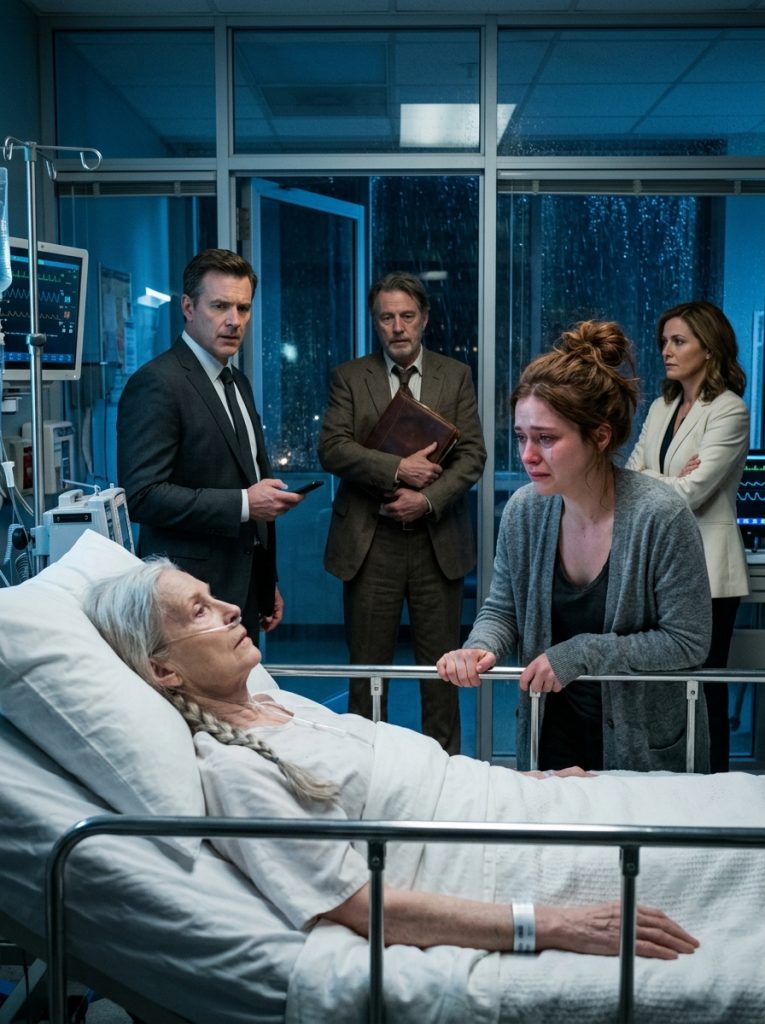
Preston set the pen down. Marcus Bell has that effect on people; forty years of being the calmest man in the room will do that.
“Who are you?” Preston demanded, recovering. “This is a family matter.”
“I’m Vivian Ashford’s attorney,” Marcus said, “and I’m here because she made me promise, years ago, that if she ever couldn’t speak for herself, I’d make sure the right person was speaking for her.”
He opened the leather folder on the rolling tray table.
“Vivian executed an advance healthcare directive six years ago,” he said. “It’s notarized, witnessed, and on file with this hospital, though it seems no one pulled it tonight. It does two things.”
He laid out the first page.
“It states her wishes plainly. She did not want to be kept on machines with no hope of recovery. That part, Preston, you’d have been right about — if that were the situation.”
He laid out the second page.
“And it names her healthcare proxy. The person with the legal authority to make decisions when she cannot.” He looked up. “It is not her son. It’s her granddaughter. Nora.”
The room tilted again, but the other direction this time.
“That’s absurd,” Diane said. “Nora’s a child.”
“Nora is twenty-seven,” Marcus said, “and she’s the one Vivian trusted. The document is binding. As of right now, Preston, you have no authority here. Nora does.”
I looked at the page with my name on it, in my grandmother’s careful blue handwriting, dated six years ago. Six years. She’d decided who I was to her long before tonight, and she’d never said a word.
The attending physician came in then, and Marcus asked the question I’d been too frightened to ask.
“What is her actual prognosis? Not the worst case. The real one.”
And the doctor — who had been talking about comfort care because that’s what the loudest voice in the room had asked for — said something that changed everything.
“The infection is responding to the new antibiotics. Her numbers improved this evening. I wouldn’t have recommended withdrawing support. I’d have recommended waiting. We just hadn’t been asked to wait.”
We hadn’t been asked to wait.
I asked them to wait.
I held my grandmother’s hand and I asked for time, and for the first time that night, the machines were on my side.
She woke up two days later.
Not all at once. A flutter, then a squeeze of my fingers, then, on the third morning, her eyes opening and finding me asleep in the chair and her voice, sandpaper-thin, saying, “You’re still here.”
“I’m still here,” I said. “I’m not going anywhere.”
She came off the ventilator that week. She never went home — we both came to understand that — but she got something I will be grateful for as long as I live.
She got eleven days.
Eleven days of her own mind. Of her own voice. We ate terrible Jell-O and she made fun of it. She told me stories about my mother I’d never heard. She held court from that bed like it was a throne, and the nurses adored her.
Preston came back, once. I let him in, because she asked me to. They spoke quietly for a long time. I don’t know everything that was said. I know that when he left, his face was wet, and that he didn’t ask about the house even once.
I’d like to tell you it fixed thirty years. It didn’t. Some things come too late to be fixed; they can only be forgiven, and forgiveness is its own kind of ending. He got to say he was sorry. She got to hear it. That had to be enough, because it was all there was time for.
On the twelfth day, in the early morning, with the rain finally stopped and gray light coming up over the city, she went. Quietly. On her own terms. My hand in hers, exactly where she’d wanted it, exactly where she’d put it in writing six years before, when she chose me.
People ask if I’m angry that it was so close. That a busy night and an unread file almost took those eleven days from us.
I was, for a while.
Now mostly I think about the kind of woman who plans, in advance, in her own steady hand, to spare the people she loves from having to guess. Who looked down the road and made sure the right person would be holding her hand at the end.
She didn’t leave me the house. Preston got the house. I never wanted it.
She left me a letter, and the eleven days, and the certainty that I was, to her, the one she trusted most.
I keep the directive in a drawer now, with my own name on the line that mattered.
It’s the most loved I have ever felt by a single piece of paper.