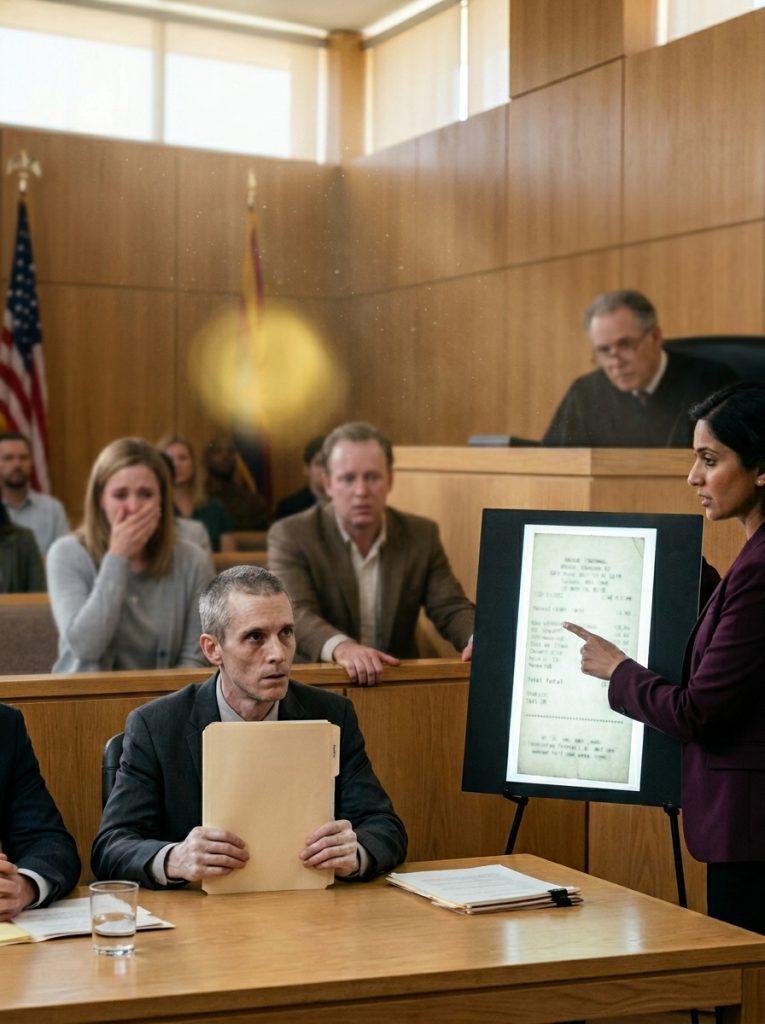
The hearing was supposed to take twenty minutes. A formality, my attorney kept saying. Then the forensic examiner set the receipt on the easel, and the entire room forgot how to breathe.
Nine years. That’s what one gas station receipt cost me when twelve tired people decided it was a fake.
Let me tell you about that night. October, nine years ago. I was 200 miles north, in a town near the state line, filling my truck at a pump at 11:48 p.m. I bought gas, a coffee, and a pack of gum, and I kept the receipt in my console because I keep everything. Time-stamped. The exact window the prosecutor would later swear I was breaking into a warehouse back home and putting a man in the hospital.
At trial, that receipt was my whole alibi. And the state took it apart in front of the jury. The thermal ink had faded — those flimsy slips always do within a year — so the prosecutor told the jury I must have printed it myself. “Conveniently produced.” No camera footage had been pulled from the station; nobody bothered in time. My public defender had nine other cases that week. The jury was out four hours.
Guilty.
I missed my mother’s funeral from a cell. My daughter learned to ride a bike, lost her first tooth, started middle school, all in visiting rooms behind glass. You don’t get those back. I want to be honest about that, because no part of what came next gives them back.
Then the Innocence Project took my case. And they did the one thing no one did in 2016: they sent that receipt to a real forensic document examiner, Dr. Priya Anand, who looked at it under infrared and multispectral imaging — light that reads ink the human eye lost years ago.
This morning, in a courthouse in Tucson, she stood up in white gloves and held that receipt up, blown up four feet tall on a board, every faded line pulled back from the dead.
“The thermal substrate degradation is consistent with a genuine slip aged nine years,” she said. “The printer’s mechanical signature matches the station’s register. And the station’s own transaction log — recovered from the corporate archive — records this exact sale, this exact timestamp, this exact pump. 11:48 p.m. Two hundred miles from the scene. This receipt is authentic. It is, frankly, unforgeable.”
I heard my sister Dana sob behind me.
And three rows back, my brother-in-law Lonnie — Dana’s husband — gripped the gallery rail and went the color of paper.
Here’s the thing nobody at trial knew. The night it happened, Lonnie had borrowed my truck. He told everyone I was driving it. He was the one near the warehouse. And when it went wrong, he let me put my hand on a Bible and swear I was at a gas station, and he let twelve strangers decide I was lying about the one true thing I had.
The judge, Harlan Reyes, studied that receipt for a long, long time. Then he looked at me. Then he turned to the prosecutor and asked one question, quiet as a held breath:
“Counsel — if the defendant was two hundred miles away at 11:48, who was driving his vehicle?”
The prosecutor had no answer. But Lonnie did. He stood up in the gallery — nobody asked him to — and in front of everyone he said, “It was me. God forgive me. It was me.” And he started to cry the way a man cries when nine years of carrying something finally crushes him.
They cleared the gallery. They took Lonnie into a side room. My attorney gripped my shoulder and said, “Wesley. It’s over.”
Judge Reyes vacated my conviction that afternoon. Two weeks later the charges were formally dismissed and my record wiped. They gave me a folder, a handshake, and an apology that the state read off a piece of paper.
I walked out of that courthouse into Arizona sun so bright it hurt. My daughter was waiting on the steps. She’s seventeen now. She was eight when I went in. She hugged me and said, “Hi, Dad,” like it was easy, like we hadn’t lost a whole childhood to a faded slip of paper, and I held her and didn’t let her see my face.
I don’t have a clean, triumphant ending for you. Lonnie’s facing his own reckoning now, and my sister’s marriage is rubble, and that’s its own kind of grief — he was family. I got my name back, and I’m grateful past words. But I’ll never get the funeral back. I’ll never get the bike or the tooth or the middle school back.
What I have is this: the truth was in my console the whole time. 11:48 p.m. Pump 6. It just took nine years and the right light to read it.
Keep your receipts. I mean that more than you know.