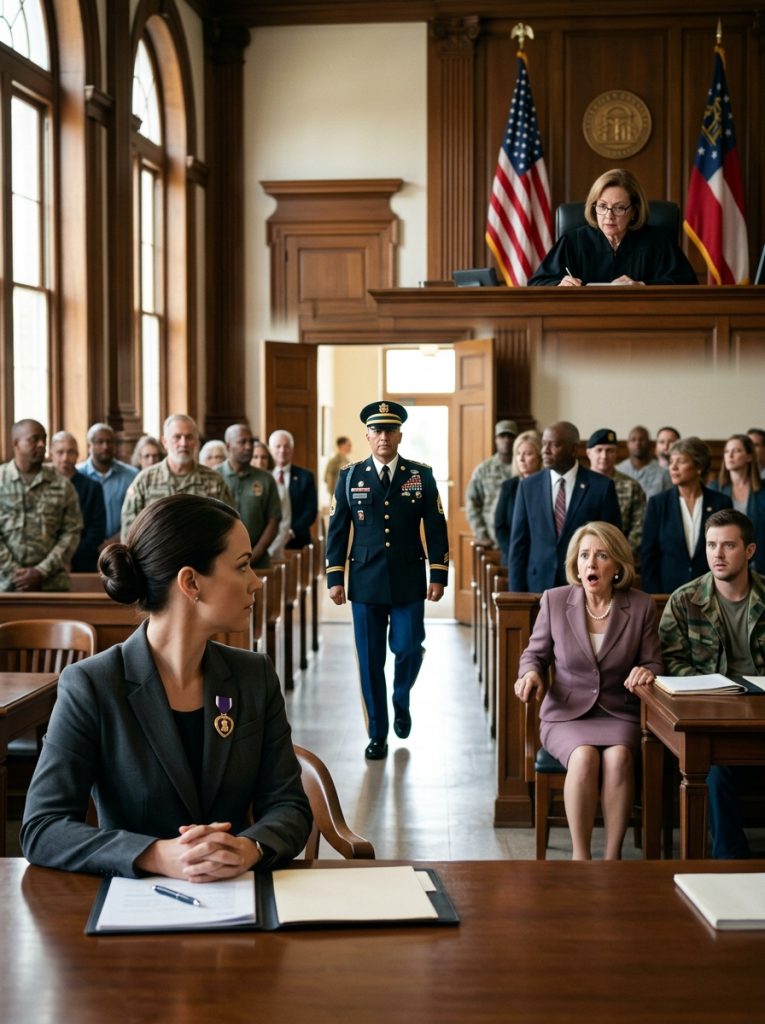
My mother put her hand on a Bible, looked a judge in the eye, and testified that I made up eight years of my life.
Eight years. Two deployments. A combat medic’s training, a Purple Heart I don’t like to talk about, and a faded shrapnel scar on my right shoulder that I’ve stopped noticing in the mirror.
“Fabricated,” she told the court. “Rachel was never in the Army. She forged the documents to manipulate my father in his final months and steal his farm.”
I sat at the defense table in a charcoal blazer with my hair pulled back, and I made myself breathe the way you learn to breathe when everything in you wants to come apart.
Let me explain how we got here. My grandfather raised me more than my mother ever did. When he passed, he left the farm — eighty acres outside Macon and the house he built — to me. Not to her. He knew what she was, and he made his choice in plain language in a will no one could misread.
My mother could not accept it. So instead of contesting the will on its terms, she went for the cleaner, crueler story: that the granddaughter who “claimed” to be a veteran had faked all of it. That the uniform was a costume. That the service was a lie I’d told a dying man.
My brother Kyle sat right behind her in a camo jacket he’d bought at a surplus store, nodding along, smirking. Kyle has never worn a real uniform in his life. The closest he’s come to a deployment is a hunting trip.
And here’s the thing I have to admit: for a few minutes, watching the judge nod politely while my mother performed her grief, the old fear crawled up my spine. The fear that the most respectable-looking person in the room always wins. My mother in her mauve suit and pearl earrings looked like somebody’s idea of a trustworthy woman. I looked like a defendant.
Then the doors at the back of the courtroom opened.
I hadn’t arranged it. I didn’t even know he was in Georgia. But word travels through a unit faster than any lawyer, and somebody had made a call.
Sergeant First Class Hector Ramos walked down the center aisle in full dress blues, every ribbon squared away, and the whole gallery turned. My mother stopped mid-sentence. Her lawyer shot to his feet objecting that the witness wasn’t on any list, and Judge Ellison — reading glasses down her nose, not a woman easily performed at — said she’d allow it, and he could be sworn.
Ramos had been my platoon sergeant. He’d been beside me on the worst day I have, the day that scar happened, the day I kept two soldiers alive in the back of a vehicle that should not have been moving. He took the stand and told the court, plainly, what he’d seen me do. Then his lawyer entered what he’d brought: my DD-214, my deployment orders, my award citations — the official record, certified, the paper version of a life my mother had just sworn never happened.
The judge asked me to confirm a detail in the citation. I did. And then, because her lawyer pushed, I was asked about the injury, and I turned my shoulder and showed the scar that matched the record exactly.
But the thing that ended it wasn’t the scar or the sergeant.
It was my mother’s own words.
Years earlier, in a custody filing during a different fight, she had sworn under oath — in writing — that she was “proud of her daughter’s military service.” Her own signature. Her own notary. My lawyer laid that filing beside today’s testimony, where she’d sworn the service never existed.
You cannot swear both. One of them is perjury, and the dates made it obvious which.
Judge Ellison went very quiet. Then she found for me on every count. The farm and my grandfather’s trust were mine, confirmed and protected. And she held my mother in contempt, referred the perjury to the district attorney, and ordered her to pay my legal fees in full.
Kyle’s smirk had died somewhere in the middle of Ramos’s testimony. As we were leaving, his own ugliness caught up with him too — it came out, in the contempt proceedings that followed, that the “service” he’d implied for himself didn’t exist either, and an old administrative discharge for theft during basic training, the one he’d buried, finally surfaced on the record.
So I won. Completely. On paper, it could not have gone better.
I want to tell you it felt like victory. It didn’t.
I never learned, in that courtroom, exactly why my mother did it — though the lawyers traced enough debt and enough of Kyle’s bad luck at the casino to guess that the farm was always about money she’d already spent in her head. I’ll probably never get the real answer, and I’ve made my peace with not getting it.
What I do know is this: I walked into that building with a mother and a brother, and I walked out with a deed and an empty space where a family was supposed to be. You can be completely vindicated and completely alone in the same afternoon.
I keep my grandfather’s farm now. I keep the citation framed where he’d have wanted it. And I keep one thing close that no court could rule on — the memory of a man in dress blues walking down an aisle he didn’t have to, to tell the truth about a woman the whole room had been ready to doubt.
Some people show up. That’s the part I hold onto. Not the ones who were supposed to. The ones who actually do.