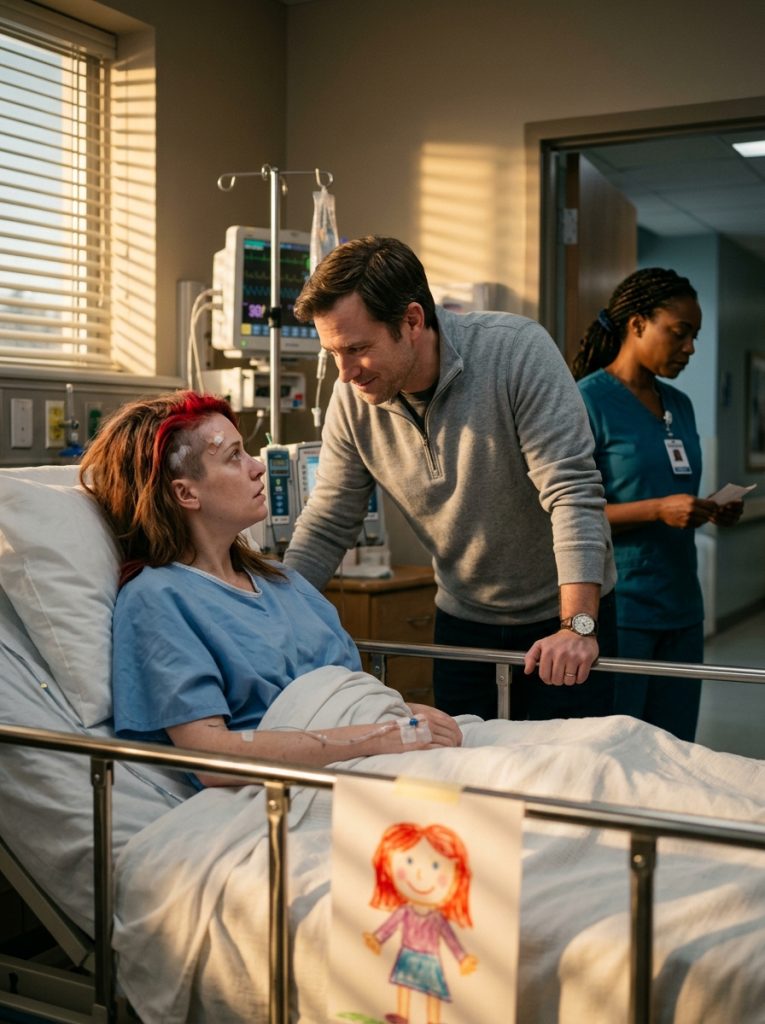
I thought waking up was the hard part. Then my husband leaned over the hospital bed and told me who I’d been.
“You weren’t a good person, Nora,” Greg said softly, holding my hand. “You were cruel. You drank. I stayed out of pity. But I’m here now. Let me take care of everything — the house, the accounts, all of it. Don’t worry your head.”
My name is Nora Bennett. I’m 35. Six weeks ago I fell down the basement stairs of our house in Portland. At least, that’s the story I woke up to. There’s a hole in my memory shaped like the last month of my life, and Greg was very gently filling it with a version where I was the villain and he was the saint.
But here’s what nobody tells you about waking with no memory: your body remembers what your mind can’t.
And my body did not trust this man.
Every time he touched my hand, my stomach turned. Every time he leaned close, the heart monitor climbed — I watched the number spike, and so did the night nurse standing in the doorway. Tessa. Teal scrubs, kind eyes that kept cutting away from Greg like it physically hurt her to listen to him.
There was a child’s crayon drawing taped to my bed rail. A woman with bright, fire-red hair.
“Your daughter made that,” Greg said when he caught me staring. “Don’t get attached to the picture. You dyed your hair brown for years. You hated the red — said it made you look cheap. That’s the kind of thing you cared about.” He smiled. “It’s okay. You don’t have to remember.”
But my roots were growing in red. Bright red. The brown was a fading dye someone had put over my real self. And my little girl — wherever she was, whoever was keeping her from this room — still drew her mother with red hair. Because that’s who I really was. Children don’t lie about the color of their mother.
When Greg finally left to “handle some paperwork,” Tessa came in to check my IV. She didn’t say a word. She just smoothed my blanket, and as she did, she pressed something small and folded into my palm and closed my fingers over it.
I waited until the door clicked shut. Then I unfolded it.
Eight words, in a nurse’s fast, slanted hand:
“Your sister Marian is in the parking lot.”
My sister. I had a sister. The name landed in my chest like a key turning in a lock I didn’t know was there. Greg had never once mentioned a sister.
“He told us family only,” Tessa murmured, pretending to adjust my line. “Said your sister ‘agitates’ you. She’s been in that lot for four days, Nora. She’s not allowed past the desk. I’m not supposed to do this.” Her eyes finally met mine, steady. “But I’ve been a nurse twenty years, and I know the difference between a grieving husband and a man building a story. Your monitor knows it too. So I’m asking — do you want me to bring her up?”
I said yes before I could think.
Marian was through the door in ninety seconds, and the moment I saw her face — older than mine, same nose, eyes spilling over — something in me cracked open and a hundred wordless things rushed back. Safety. Childhood. Truth.
She held my face in both hands and told me everything Greg had spent six weeks erasing.
I had not been a cruel drunk. I’d been a daughter who inherited her late father’s small machine-parts company — and a wife who, three months ago, found out her husband had been quietly draining it. Forging signatures. Moving money. I’d hired a lawyer. I’d told Marian on the phone, the week before the “fall,” that I was done, that I was getting Lily and leaving.
“You called me from the bottom of those stairs, Nora,” my sister whispered. “Not after. During. You and Greg were arguing at the top about the lawyer’s letter. The call cut off. By the time the ambulance came, he had a story ready — that you’d been drinking, that you slipped, that you’d been ‘unstable for months.’ He told it to the police. He told it to the doctors. He told it to everyone before you ever opened your eyes, so that if you woke up confused and accused him, you’d already be the unreliable one.” She gripped my hands. “And he filed for power of attorney over you and the company two days ago. There’s a stack of papers. He’s been waiting for you to be lucid enough to sign — and confused enough not to read.”
The papers. Don’t worry your head. Let me handle the accounts.
I didn’t sign them.
When Greg came back with his pen and his soft voice and the folder open to the signature line, I looked at him with my red roots and my sister’s hand in mine and Tessa squarely in the doorway, and I said the truest thing I knew: “I don’t remember the stairs. But I remember that I don’t trust you. And I’d like you to leave.”
He tried the smile. It didn’t fit anymore.
The lawyer I’d hired before the fall still had my file. The police reopened the “accident” once Marian gave them the timeline and the phone records showed my cut-off call. The forensic accountant found everything Greg had moved. It will be a long road — fraud cases always are — but he is out of my house, and the protective order means he comes nowhere near Lily or me.
My hair is fully red again now. I cut the brown off in one afternoon, sitting in Marian’s kitchen, and my daughter laughed and said, “There’s Mommy.”
I never got my memory of those stairs back. Maybe I never will.
But I learned something worth more than the memory: you can take a person’s past and rewrite it while they sleep. You cannot rewrite what their own body knows. Mine knew. The monitor knew. A stranger in teal scrubs knew.
And a little girl with a box of crayons knew exactly what color her mother was supposed to be.