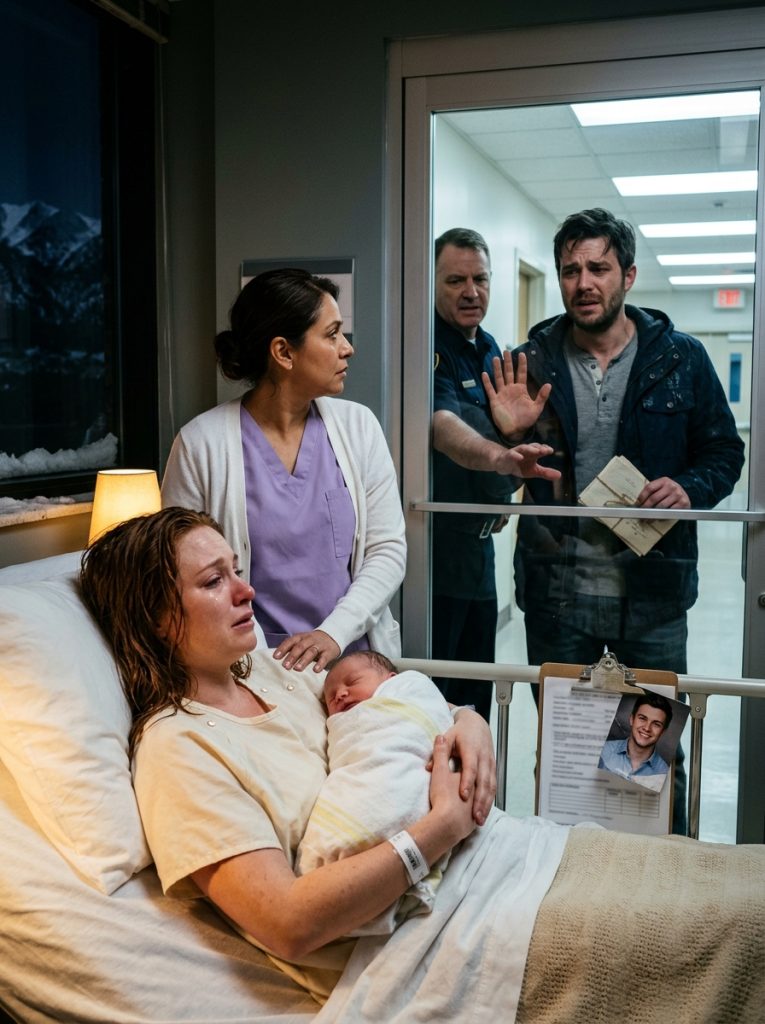
“There’s a man in the hallway. He says it’s about the baby.”
I’ll never forget the way the nurse said it — careful, like she was setting down something breakable.
I’d been at St. Agnes Memorial for fourteen hours. Alone. My mom passed two years ago, my dad’s not in the picture, and the one person who was supposed to be holding my hand had vanished seven months earlier. So a labor nurse named Renata held it instead, and told me I was doing beautiful, and I believed her because I had no one else to believe.
When they laid my daughter on my chest at 11:52 p.m., I cried for a hundred reasons and only let myself name one.
Forty minutes later, there was a man pacing the corridor, and it was not Daniel.
“Send him away,” I said. I was so tired the room was swimming.
“He says his name is Eli,” Renata said. “He says he’s Daniel’s brother. He’s been crying, honey. And he’s holding a stack of mail.”
Eli. I’d met him twice, years ago. Quiet, kind, the brother who fixed things.
They let him to the doorway. Security stayed close. He was soaked to the bone from the snow, and his hands were shaking around a thick bundle of envelopes tied with kitchen string.
Every envelope said RETURN TO SENDER. Every one was addressed in Daniel’s handwriting. To me.
“He didn’t leave you,” Eli said. His voice broke clean in half. “Nora, he never left you.”
And then he told me the thing I had built my whole pregnancy to survive without.
The night Daniel “disappeared” — the night I told him we were pregnant and he kissed me and said he was driving to his mother’s to get his grandmother’s ring — he never made it. A truck ran a light on Route 6. Daniel’s car went into the median.
He spent eleven days in a coma. He woke up with a traumatic brain injury, a shattered pelvis, and months of not being able to form the words he wanted. He couldn’t remember his own phone passcode. He couldn’t walk to a mailbox.
But he remembered me. He remembered us. The first full sentence he managed in rehab, Eli said, was “Does Nora know I’m okay?”
And here is the part that still makes my hands shake.
Their mother, Patricia, took over everything while Daniel was unconscious. His phone. His mail. His “recovery.” And Patricia had never thought I was good enough for her son.
She told me he’d moved on. She told him I’d ended it — that I’d said a baby and a broken man were too much, that I’d asked them all to leave me alone. She intercepted every letter he wrote me from that rehab bed and sent them back herself, RETURN TO SENDER, so he’d believe I never wanted them.
For seven months, each of us thought the other had walked away. And one woman stood in the middle, holding both ends of the rope.
“How did you find me?” I whispered.
“He kept asking for you,” Eli said. “Every week. I finally went through Mom’s desk. I found the letters in a drawer. All of them. And a hospital pre-registration form with your due date on it.” He swallowed. “I drove straight here. He doesn’t even know. He doesn’t know she’s born.”
I looked down at my daughter. I looked at the letter on top of the pile, dated the day after the accident, the handwriting crooked and desperate and his.
“Where is he right now, Eli?”
“Recovery facility. Forty minutes north. Nora — he can walk again now. Short distances. He’s been saving up so he could come find you himself. He just doesn’t know where you went.”
I made them get a wheelchair. I made them call the facility. It was past midnight and a nurse named Renata broke six rules to make it happen, and I will love her until I die.
Daniel was awake when we rolled into his room at 2 a.m. — he never really sleeps, the night nurse said, he just waits. He saw me first. Then he saw the bundle in my arms, and his face did something I have no words for, eight months of grief and disbelief collapsing into one sound.
“You came,” he kept saying. “You came, you came.”
“I never left,” I said. “Neither did you. We were lied to, Daniel. Both of us.”
He held our daughter against his chest with arms that had to relearn how to hold anything, and he wept into her blanket, and I climbed onto that narrow hospital bed and held them both.
We’ve spent the months since untangling it. Patricia is not in our lives anymore — not because I’m cruel, but because some things you cannot unsend, and a drawer full of returned letters is one of them. Eli is the godfather. He earned it.
Daniel walks our daughter up and down the hallway every evening now, a little farther each night, the way he relearned everything. And every time he passes the front door, he checks that it’s unlocked.
“Just in case,” he says, “someone’s trying to find their way home.”
They always were. We just had to stop believing the person who told us the door was closed.