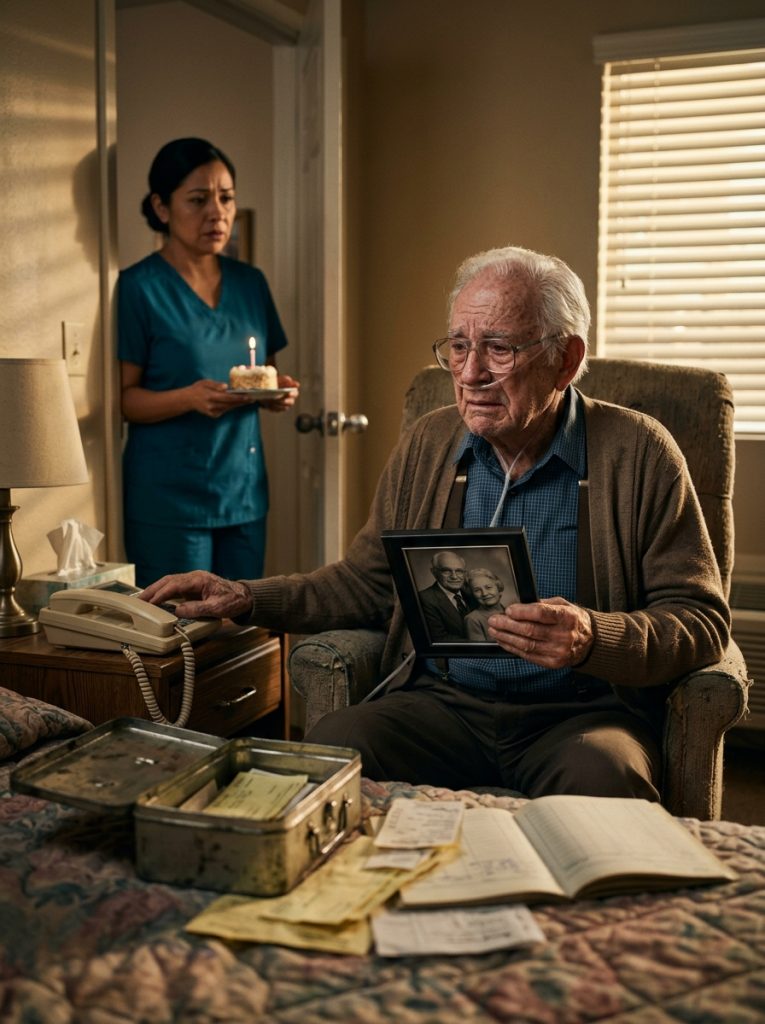
My son posted a photo of me on my eighty-fifth birthday.
“Happy Birthday to my amazing Dad. 85 today. Love you more than words.” Four hundred likes. My daughter shared it. A nephew left a row of little hearts.
Not one of them called.
I know exactly what time the post went up, because I sat by the phone in my room at Desert Vista all day, and the phone is the only thing in here worth watching. I know they had the time. Typing those words for their followers takes longer than dialing my number.
It had already been a hard morning before the phone started its silence. I’d reached for your grandmother’s photograph on the shelf — the black-and-white one, the only thing in this room that’s really mine — and my legs went out from under me. Lupe, the day aide, found me on the floor. Good girl, Lupe. Teal scrubs, hair pulled back, the kind of patience you can’t fake. She called all three of my children before noon.
Greg didn’t pick up. Sharon didn’t pick up. The youngest didn’t either.
So I waited. You get good at waiting in a place like this. The desert light came across the floor and moved along the wall, and the phone stayed dark, and somewhere out there the little hearts kept stacking up under a photo of a man they couldn’t be bothered to call.
I’m not telling you this for pity. I had a good life. Forty-one years in a machine shop. Never owed a man a dollar. Drove the same car for fifteen years and people thought I was just cheap.
But there are things my children never knew about those forty-one years, and I kept them that way on purpose.
When Greg’s business went under, the bank was three days from taking his house. The money that saved it came from nowhere, he always said. A miracle. It came from me. A second mortgage on my own place that took me nine years to pay back.
When Sharon and her husband couldn’t have children and the treatments cost more than they could ever say out loud, the clinic told them an anonymous family fund had covered the balance. There was no fund. There was me.
My granddaughter Mia’s tuition. The deposit on Greg’s daughter’s first apartment. The medical bills nobody talks about. Me, me, me — quiet, every time, with a note that said only “a friend.” I never wanted the credit. I wanted them to stand on their own and believe they’d done it themselves. That’s what a father’s money is for. It’s supposed to be invisible.
I kept the records in a locked tin box. Bank slips. Canceled checks. A ledger in my own handwriting, thirty years of it. I never opened it in front of anyone. I planned to take it with me.
Mia changed that.
She’s the only one who visits — comes on Sundays, hoodie and a backpack, sits with me even when I’m dozing. That afternoon, while I slept in the chair, she was looking for my reading glasses and found the tin instead. And being twenty-two and curious and kind, she opened it.
I woke to her sitting on the floor with thirty years of my secrets spread around her, tears running straight off her chin onto a canceled check made out to her own university.
“Grandpa,” she kept saying. “Grandpa, this was you? All of it was you?”
I told her to put it away. I told her it didn’t matter now. She wouldn’t.
She took out her phone, and under that beautiful, hollow “Happy Birthday Dad” post with its four hundred likes, she wrote what she’d found. The mortgage. The clinic. The tuition. The car I never replaced. The man who fed his children’s lives from the dark and let them think it was luck.
By evening the whole town that follows my family knew what kind of man had been sitting alone by a phone all day.
They came at nine o’clock that night. All three of them, into a hospital room — because by then my chest had gotten bad and Lupe had sent me over to be safe. Greg got there first, still in his ski jacket, and he couldn’t even get the first word out. Sharon stood in the doorway in her cream coat with her hand over her mouth.
They wanted to talk about the money. I didn’t.
“I didn’t do it so you’d owe me,” I told them. “I did it so you’d be all right. You being here is the only thing I ever actually wanted, and you could’ve had that for the price of a phone call.”
Greg held my hand and apologized until the words stopped meaning anything. Sharon cried the way you cry when you finally understand something it’s almost too late to understand.
I forgave them. Of course I did. You don’t get to eighty-five holding things. But I want to be honest with you, because the truth is the only thing I have left worth giving away:
Forgiveness doesn’t return the years. They have a father now, fully, finally — and I have less time left than the time they spent not calling. The vindication came. The hearts turned to apologies. And none of it gives me back a single quiet afternoon by that phone.
So if you’ve still got a parent sitting somewhere by a phone — don’t post about them.
Call them.
That’s the whole story. That’s all I learned in eighty-five years that’s worth passing on.