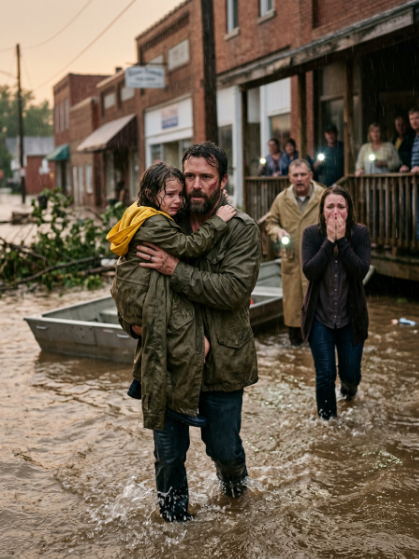
He came back out of the dark with my daughter in his arms.
The flashlight beam swung up first, then his shape, chest-deep, fighting a current that wanted to take them both. Maddie’s yellow raincoat was a smear of color against his soaked jacket. Her arms were locked so tight around his neck that later they’d have to coax her loose.
“She caught a roof,” Eli called over the water. “Climbed up on the Petersons’ shed all by herself. She’s a smart girl.”
I went into the flood up to my waist before two men grabbed me. They handed her down into my arms, and she was cold and shaking and absolutely, impossibly alive.
I will never forget the sound that came out of me.
Eli stood in the water a moment longer, like he wasn’t sure he was allowed to come the rest of the way to shore. Like he had done his part, and the town would want him gone again now.
Sheriff Boyd waded out and put a hand on his shoulder. The same Boyd who, two hours earlier, had told him to go home.
“How did you know where to look?” the sheriff asked. “We had the whole department on the east bank.”
Eli’s eyes went somewhere far off.
“Because I lost somebody in that exact stretch,” he said. “A long time ago. And I’ve walked it every spring since, so I know where the water pushes a small body, and where it lets one go.”
The crowd on the porch went quiet in a different way than before.
Here is what our town had decided about Eli Crane. That the scar on his jaw came from a bar fight. That a man who lives alone at the end of a gravel road, never comes to church, and never explains himself, must be hiding something ugly.
Here is what was actually true.
Twelve years ago, Eli had a wife and a four-year-old daughter named June. They were driving home in a storm just like this one when the low-water bridge over the creek washed out in the dark. The truck went in. Eli got his wife to the bank first. Then he went back for June.
He didn’t reach her in time.
The scar is from the guardrail he climbed trying to get to her. He has worn it like a sentence ever since.
He never told the town any of that. He just went quiet, and a town will fill a man’s silence with the worst thing it can imagine, because that is easier than sitting beside his grief.
For twelve years we let ourselves believe we were right about him. It was simpler than admitting we’d abandoned a neighbor at the worst moment of his life.
And then a little girl went into the same water that took his daughter, and the man everyone crossed the street to avoid was the only one who walked toward it.
I keep thinking about that. How the people who knew these roads, who’d lived here their whole lives, stood safe on the bank. And the outcast was the one who went in.
The morning after, his gravel road filled with cars. Casseroles. The kind of apology that comes too late to be what it should have been. Mrs. Carrow, who once stood up at a PTA meeting and said Eli shouldn’t be allowed near the elementary school, came to his porch with a peach pie and no idea what to say.
He took the pie. He said thank you. He did not pretend the last twelve years hadn’t happened, and I respected him for that. He didn’t make it easy for us. Some things shouldn’t be easy.
The county wanted to give him a medal at the spring festival. He declined the stage. But he let Maddie hand him a card she’d drawn herself — a stick figure in a yellow coat holding hands with a tall figure with a beard, both of them standing on dry ground, a blue scribble of water safely below them.
He keeps it on his refrigerator. I’ve seen it.
Maddie asks about him all the time now. She calls him Mr. Eli. He has taught her how to read the creek — which stones mean it’s rising, which sound means run for high ground. The lessons he wishes someone had given June.
“So you’ll know,” he told her. “So you never have to wait on a roof again.”
Last Sunday, for the first time in twelve years, Eli Crane walked into the diner on Main and sat down at the counter, and three different people slid over to make room before he could even decide whether to stay.
He didn’t say much. He never does.
But he came back to the table this town had shoved him away from — the same way he came back through that black water — and this time, we were the ones who finally moved over.